
The vaults of the cathedral suffered from the blaze in different ways: some were destroyed by the falling spire or framework elements, others were damaged by heat or water. Once secured by the wooden arches positioned in 2020-2021, they could be restored.
Although damaged by the flames, the coped walls surmounting the walls of the cathedral over the beginning of the vaults support the framework. Their stones had been replaced progressively in order to provide a more solid base for the framework.
Desalinating the vaults
The water used to extinguish the fire led to the appearance of mineral salts that weaken the masonry, wich had to be desalinated.
A protocol was established: compresses based on a mixture of kaolin and clay are placed under the vaults. They dry in a few weeks and draw out the salts contained in the stones, then fall off. The joints have to cleaned out with a chisel in order to definitively eliminate harmful chemical reactions.
Restoring the vaults
Next comes the reconstruction of the collapsed vaults. The first vault to benefit from this treatment was the vault of the North arm of the transept, a vaulting of which was reconstructed in November 2022.
Stonecutters and masons reconstructed the vaulting identical to the original, using stones and mortar in accordance with the original construction methods: the carpenters first placed wooden struts between the arches under the zones to be reconstructed. The stonecutters and masons then positioned the beveled stones on these struts, thus enabling the reconstitution of the form of the vaulting.
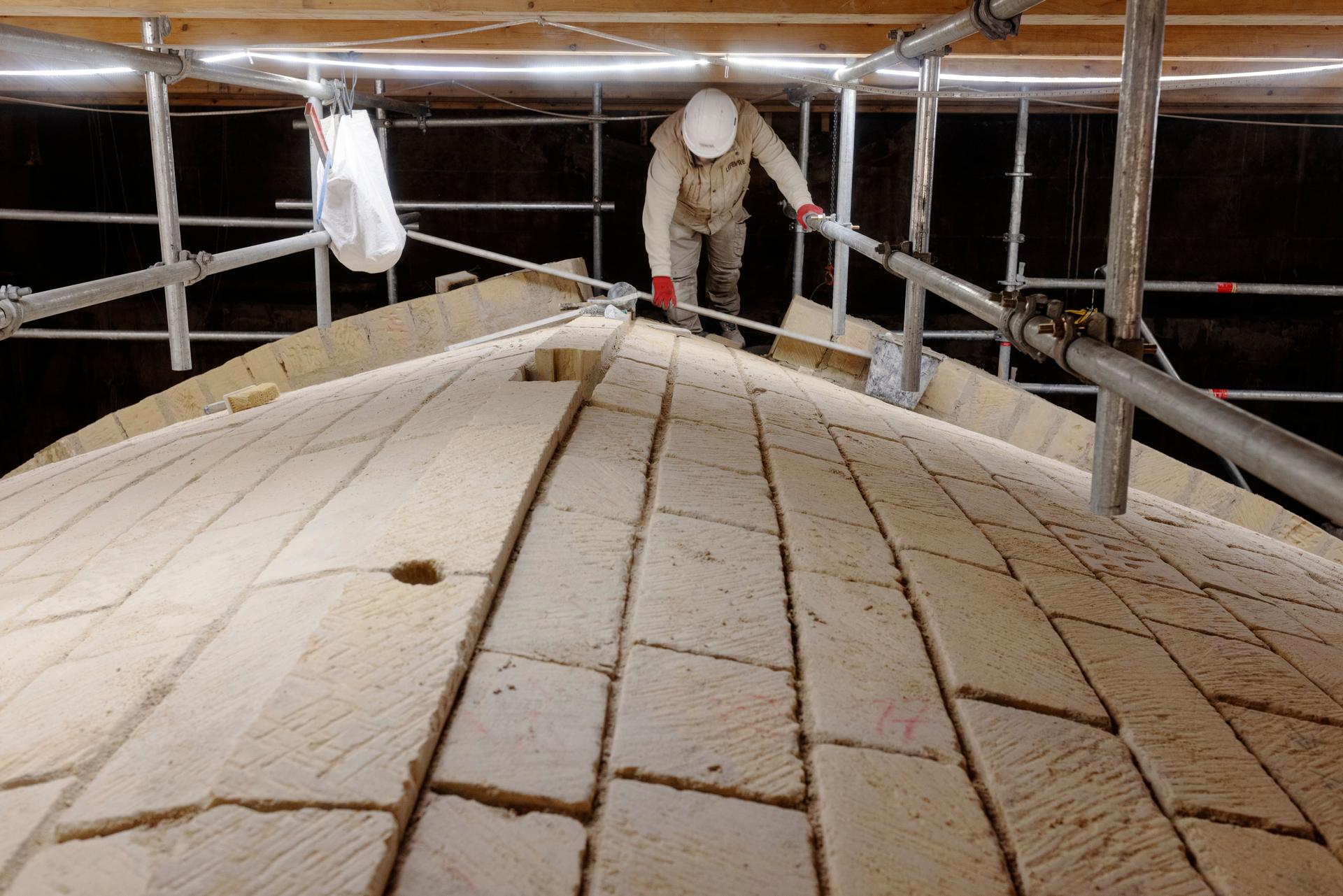
The masons laid a layer of lime and sand reinforced with a trellis on the extrados of the vaults of the transept arm. This reinforced layer consolidates the extrados of the vault and protects the vault from any possible seepage.
The restoration of the vault of the transept crossing
The vault of the transept crossing, under the future spire, the heart of the project by virtue of its geographical location but also because of its symbolic importance, is the subject of restoration in several stages.
When the scaffold installed at the transept crossing to reconstruct the spire (see below) reached the level of the beginning of the vaults at a height of 26 meters at the end of October 2022, the carpenters assembled and raised up the four wooden arches that make up the framework that is indispensable for the stonecutters and masons in order to rebuild the arches of the vault of the transept crossing. This ephemeral structure was completed by a wooden ring positioned where the arches intersect. This supports the reconstruction of the compression ring, also called the oculus, which constitutes the keystone of the transept crossing.
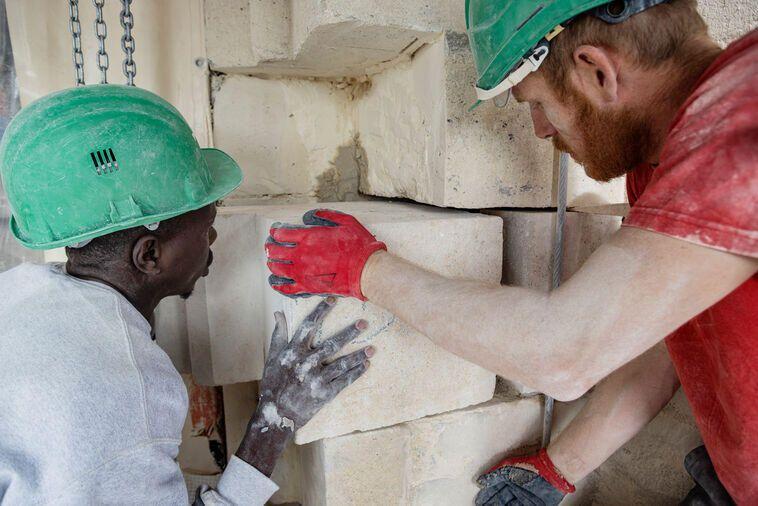
In February 2023 the stonecutters and masons placed the stone voussoirs on this wooden structure. Previously cut in the workshop, the voussoirs were delivered to the work site via the Seine.
The scaffold was then extended to accommodate the base of the spire. Once the framework of the spire is finished and its covering is installed, the scaffold is dismantled and the vault of the transept crossing can be completed by installing the vaultings. The last stone is placed on the 16 May 2024.
Restoring the coped walls and tracery
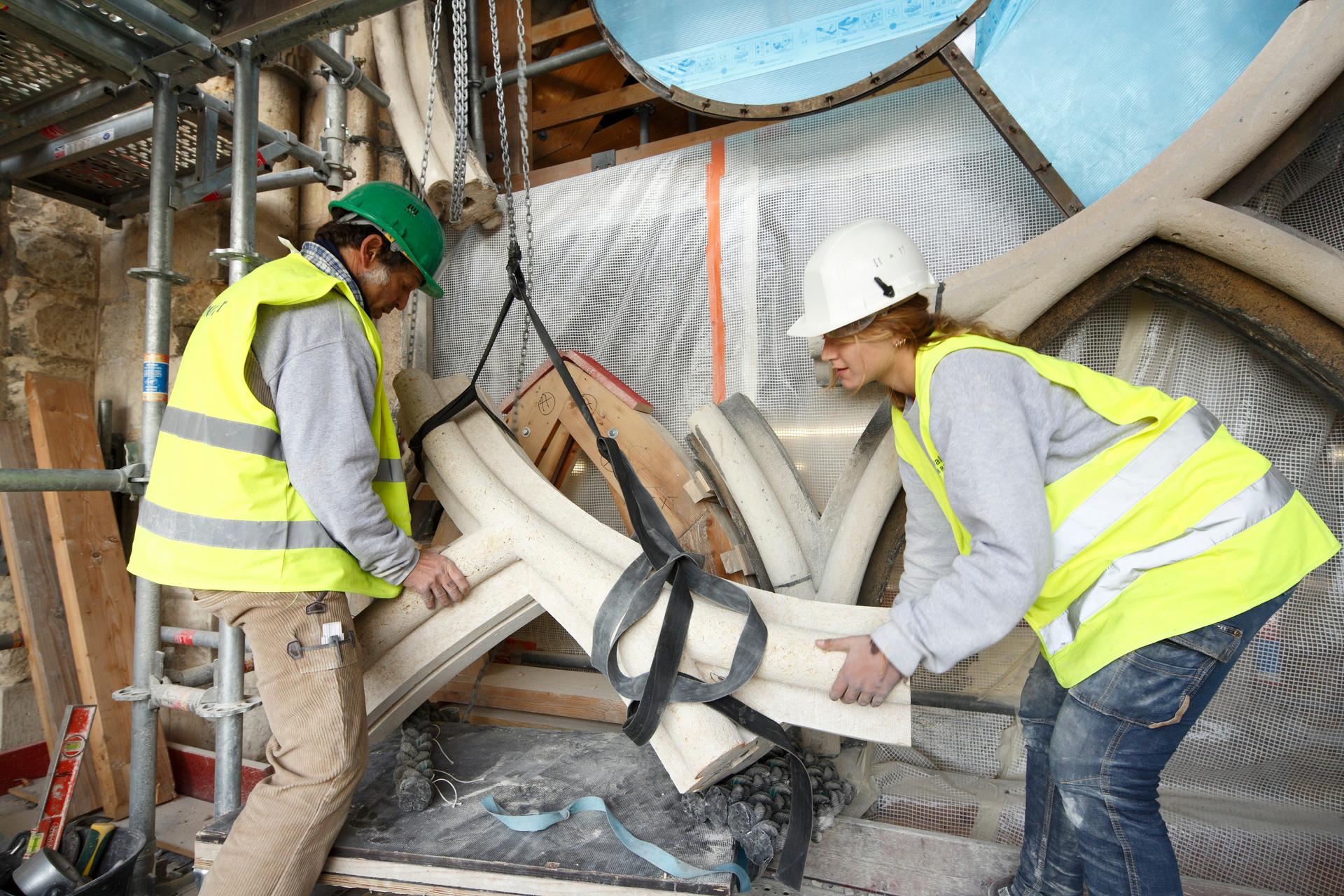
In addition to the collapsed vaults to be restored in the nave and the North arm of the transept, some of the stones of the cathedral were badly damaged by the heat from the fire and had to be either consolidated for changed. The low walls supporting the framework were the most affected. The removal of the stained-glass windows from the upper bays also provided an opportunity to intervene in some deteriorated zones of their tracery.
Protocols adapted to each situation were defined by the project management along with the Historical Monuments Research Laboratory (LRMH). Masonry that suffered superficial damage was thus consolidated by an injection that solidifies the core of the stone, known as the substrate, and its outer layer, or skin. When the masonry is too badly damaged, the affected parts are carved out, or dug out until the healthy part is reached, and a new cut-to-measure stone fills the space thus created. Particularly damaged by the fire, the stones in the upper masonry of the coped walls at the crossing of the transept had been replaced from October 2022. It is important for them to have the necessary solidity and resistance because they serve as a base for the framework of the spire.
The stonecutters and masons also intervened on the tracery of the upper bays, the stone structure supporting the stained-glass panels. They selected stone blocks weighing between 150 and 300 kg for their appearance and for their hardness and sculpted and adjusted them to the nearest centimeter in order to obtain the profile of the original stone.
Restoring the gables of the two arms of the transept
The North and South gables of the cathedral transept, greatly damaged by the fire, had been propped up in the days following the fire. In association with the project management, the stones have then been assessed by the company in charge of restoring them.
Subjected to very high temperatures, many of these stones split or cracked. The whole North gable and some of the masonry in the South gable had to be removed and replaced by new stones. It is essential for them to be particularly strong in order to support a part of the framework but also to resist the winds they are exposed to.
To this end, additional scaffolding was installed around the two gables in 2022 to facilitate operations. The stonecutters and masons took charge of removing the damaged stones, then replaced them with new blocks prepared in the workshop that presented the same technical and aesthetic characteristics.
The opening of a sculptors' lodge on-site
As in the Middle Ages and the following centuries, the stone sculptors worked directly at the foot of the cathedral in a large hall known as the sculptors' lodge, which was installed specifically for them. Thus, working as close as possible to their models and guided by the chief architects for historic monuments, they fashioned the figurative elements destined to replace those that were too badly damaged by the fire. Removed from the cathedral after the fire and stored in a warehouse in the north of the Paris region, the original sculptures had been returned to the lodge to act as models.
Every day, sculptors and stonecutters from the art workshops selected by the public establishment worked in this dedicated space, fashioning the missing pieces and, when necessary, completely re-sculpting these sculptures that characterize the cathedral: capitals, chimeras, gargoyles and various other ornamental sculptures.
Main visual ©Patrick Zachmann – Magnum Photos