
The interior of the cathedral suffered indirectly from the fire and the collapse of a part of the vaults. Lead dust from the main attic in flames entered through the breaches in the collapsed vaults and had to be cleaned. This cleaning also led to restoring the walls and interior decor of Notre Dame de Paris, which had accumulated dirt over the centuries: a veritable rebirth, the like of which the cathedral had never known since its creation.
Preliminary dusting
The interior of Notre Dame was given a first dusting early in 2022: thousands of square meters vacuumed with high efficiency vacuum cleaners equipped with filters to retain lead particles. This operation was made possible by the presence of scaffolding throughout the cathedral, as well as in the upper parts, which had been installed to secure the vaults and enable them to be restored.
In-depth cleaning of the walls
To completely remove the dust, the stonecutters applied latex to the facing of interior walls and to non-painted sculpted stone decors, projecting it in the form of vapor onto the walls, where it hardened until it formed a layer that captured volatile particles. On sculpted parts, such as capitals and ribs, the application required surgical precision and was performed by sculpture restorers.
After a few days, the latex was removed like a second skin, taking the dust with it. After a final cleaning with a damp sponge the newly healthy walls could be seen in all the brightness of their sand-colored stone, which had vanished under decades of accumulated grit.
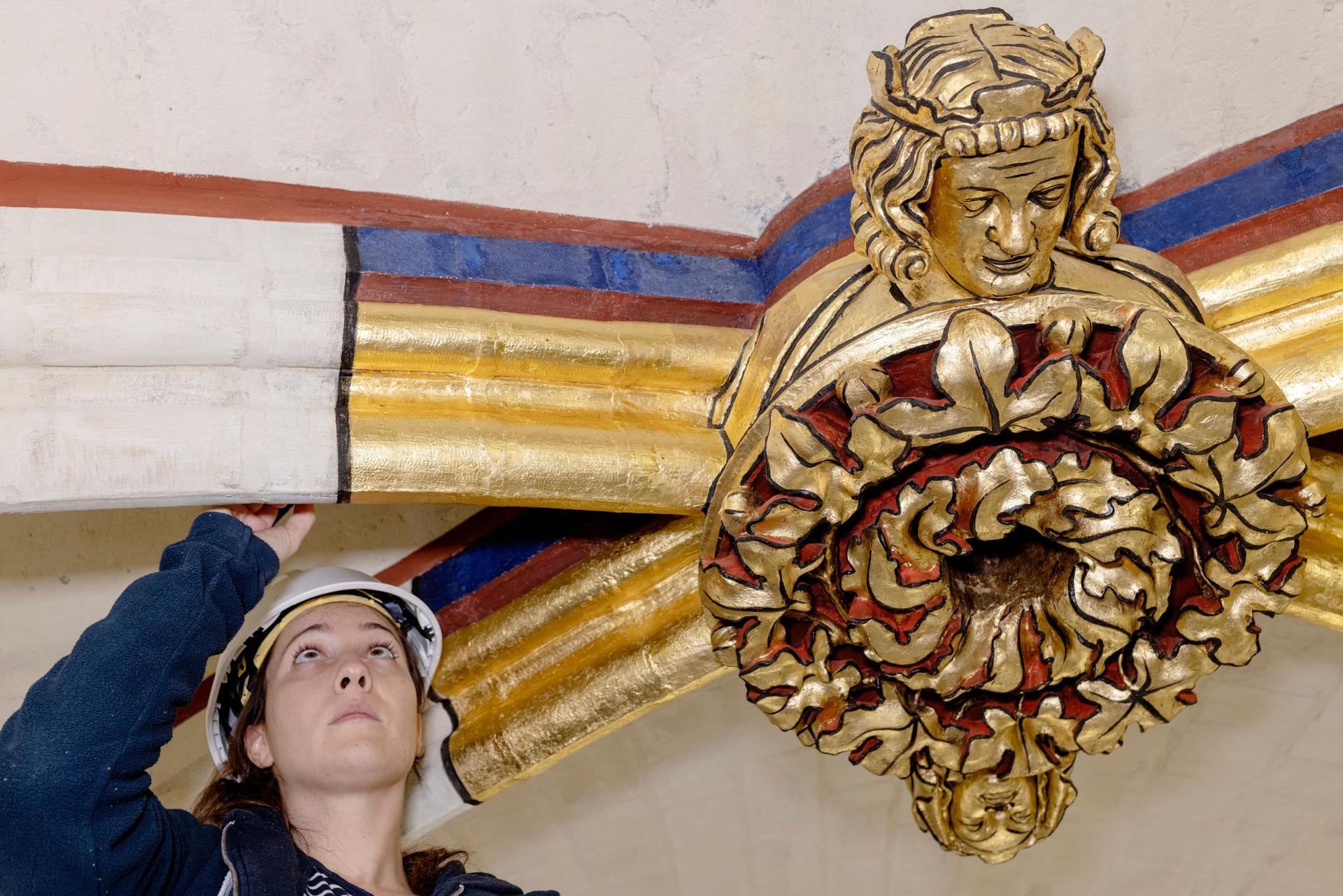
At the same time, some of the missing parts of sculpted decors had to be replaced, as in the frieze under the North rose window of the cathedral.
Cleaning the wall paintings
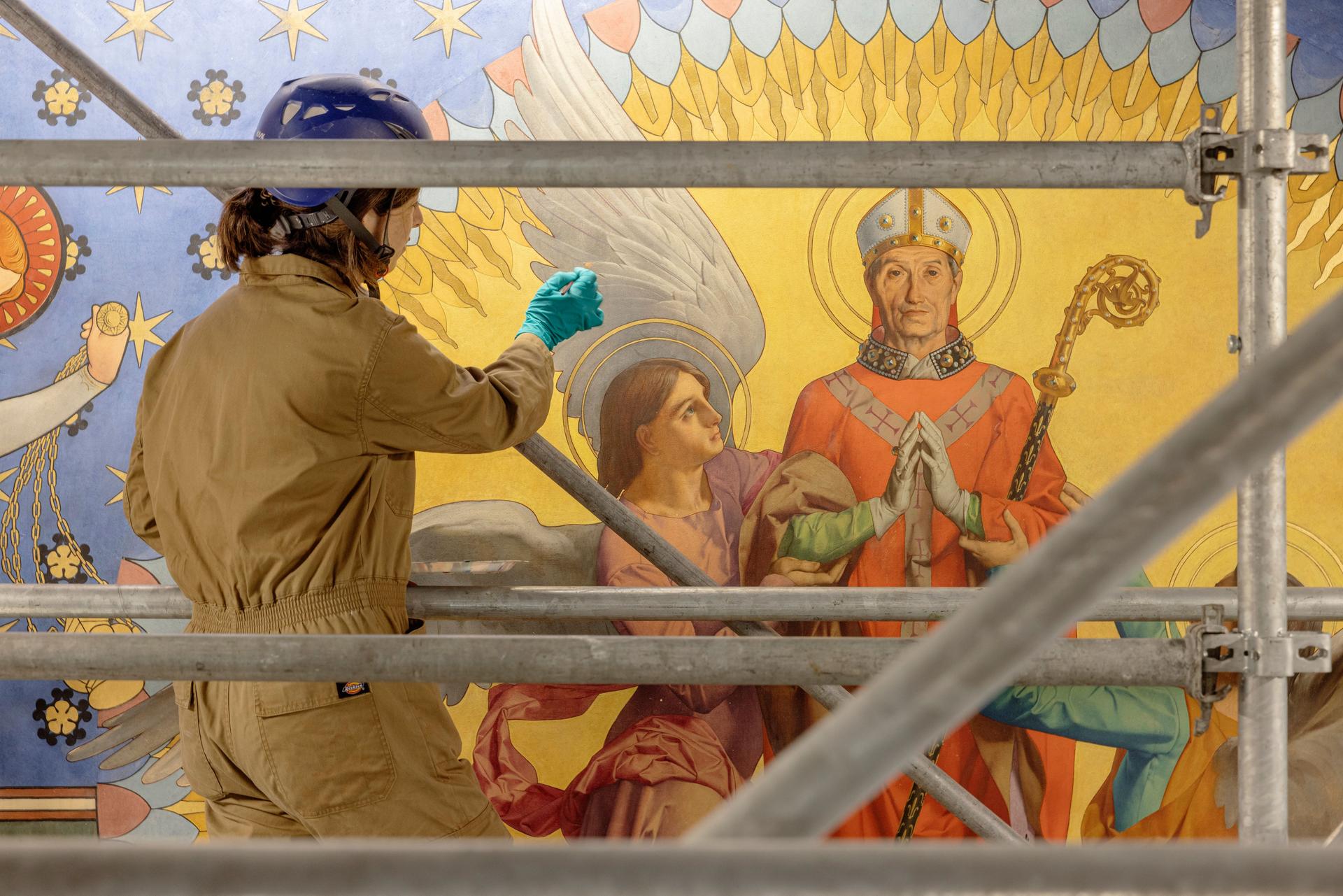
Unlike the facing in the nave and the ambulatory, as well as in the chapels of the nave, the chapels bordering the choir had been fully painted since Viollet-le-Duc's restoration in the 19th century. The same holds true of the choir closure, a vast wall adorned with historiated bas-reliefs representing the life of Christ dating from the 14th century. They were restored one after the other in accordance with the protocol established during the test restoration of the chapels in the securing phase.
Once a scaffold had been erected to 4 levels, in order to prevent further deterioration, the restorers began by re-bonding the support on which the paint was applied. Using a chemical preparation chosen during the test restoration, they cleaned the painted surface to remove the accumulated dirt. Finally, they reintegrated color pigments where lacking, being careful to choose reversible products to differentiate the original parts from restored parts.
Begun just before the summer of 2022, the restoration of the chapels of Saint Marie-Madeleine in the South and Saint Marcel and Saint Germain in the North was completed. They recovered their legibility and revealed the splendor of their original colors.
The chapels of Saint Louis, Saint Marcel and Saint Jean l’Evangéliste/Sainte Agnès are currently being cleaned, progressively revealing decors that had completely disappeared under the accumulated dirt of the years while new chapels, like the axial chapel and the chapel of Saint Georges are equipped with scaffolding to enable the wall painting restorers to intervene soon on their painted decor.
Lastly, the restoration of the choir enclosure has advanced considerably, both in the North and the South.
Cleaning the stone sculptures
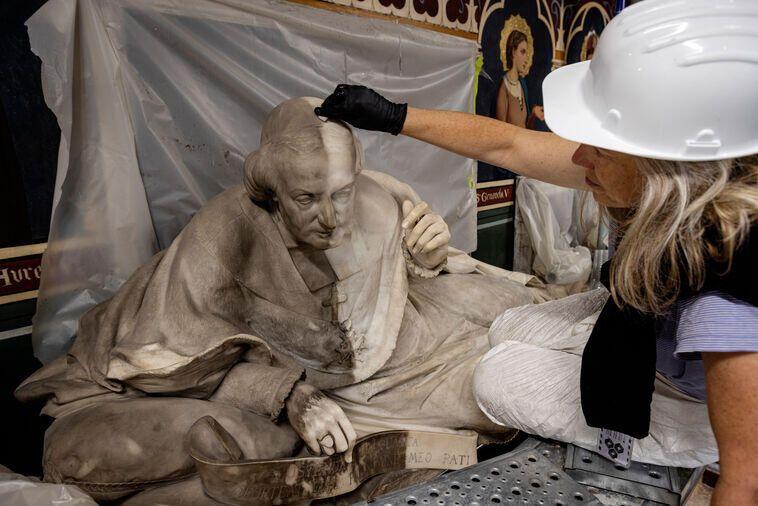
Each of the stone and marble sculptures that remained inside the cathedral was cleaned by specialized restorers.
Four mausoleums in the choir have been fully cleaned since the autumn of 2022 by sculpture restorers:
- The mausoleum of Jean Juvénal des Ursins and his wife Michelle de Vitry in Saint-Guillaume chapel;
- The mausoleum of Cardinal Jean-Baptiste de Belloy in Saint-Marcel chapel;
- The mausoleum of Monseigneur Dominique Auguste Sibour in Sainte Marie-Madeleine chapel;
- The mausoleum of Monseigneur Hyacinthe-Louis de Quélen in Saint Marcel chapel.
The sculpture restorers are currently working on the mausoleum of Albert de Gondi in the axial chapel, Notre-Dame-des-Sept-Douleurs. The sculptures located in the nave will be treated in 2023.
Restoring the railings
The presence of galleries around the central nave constitutes one of the architectural features of Notre Dame de Paris. They are characteristic of early Gothic art in the 12th century.
In the 19th century, they were provided with Neo-Gothic metal railings designed by Viollet-le-Duc.
Fully dismantled and transported to a workshop, the railings were restored and regilded by master wrought-iron workers in 2022 and will soon be returned to their original locations.
The cleaning of the interior of the South arm of the South transept was completed in December 2022. The scaffolds were dismantled, revealing what the whole monument will look like when it reopens in 2024: thanks to the work of many professions applying very varied techniques, Notre-Dame de Paris will be more beautiful than it has been for centuries.
Main visual ©Patrick Zachmann – Magnum Photos