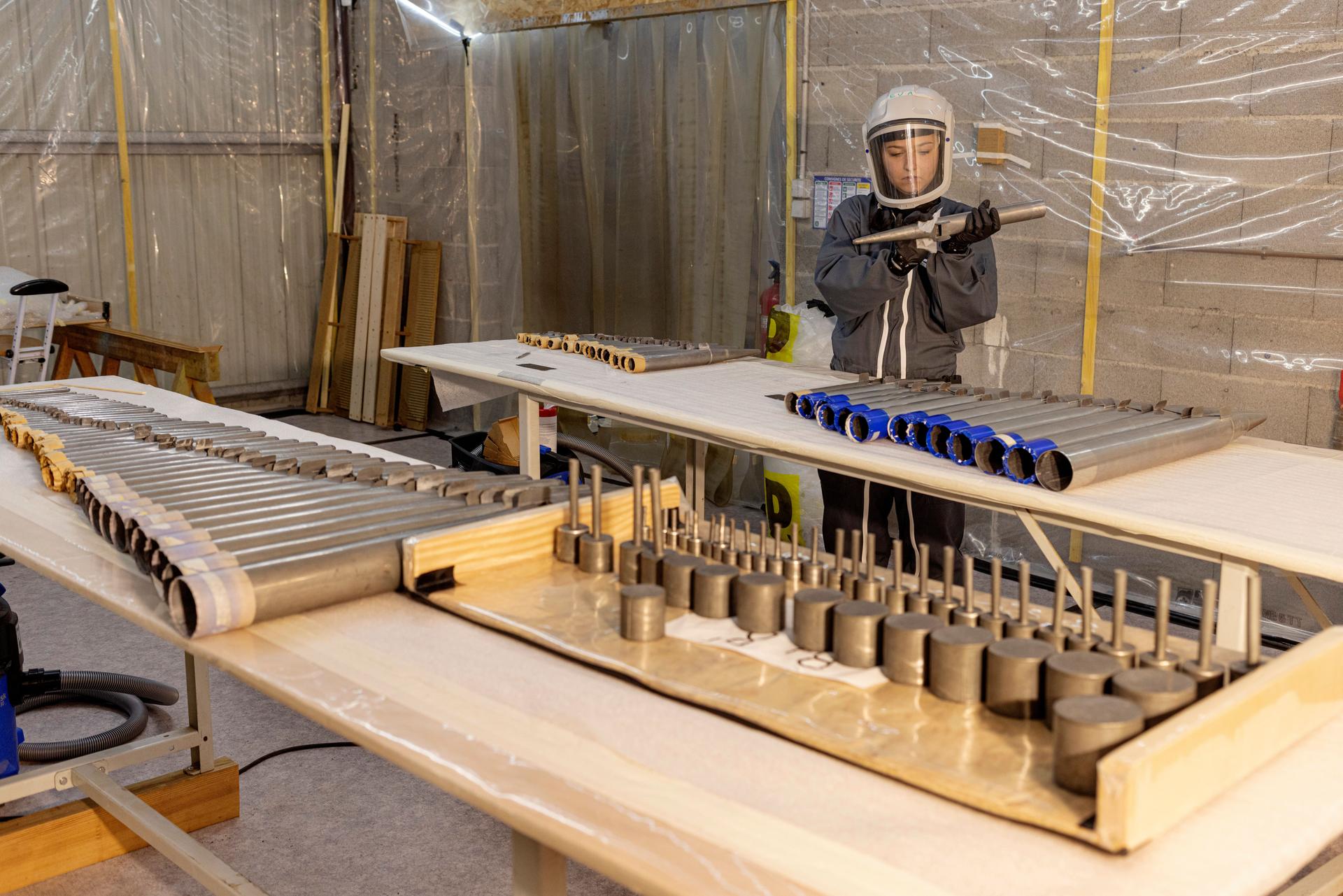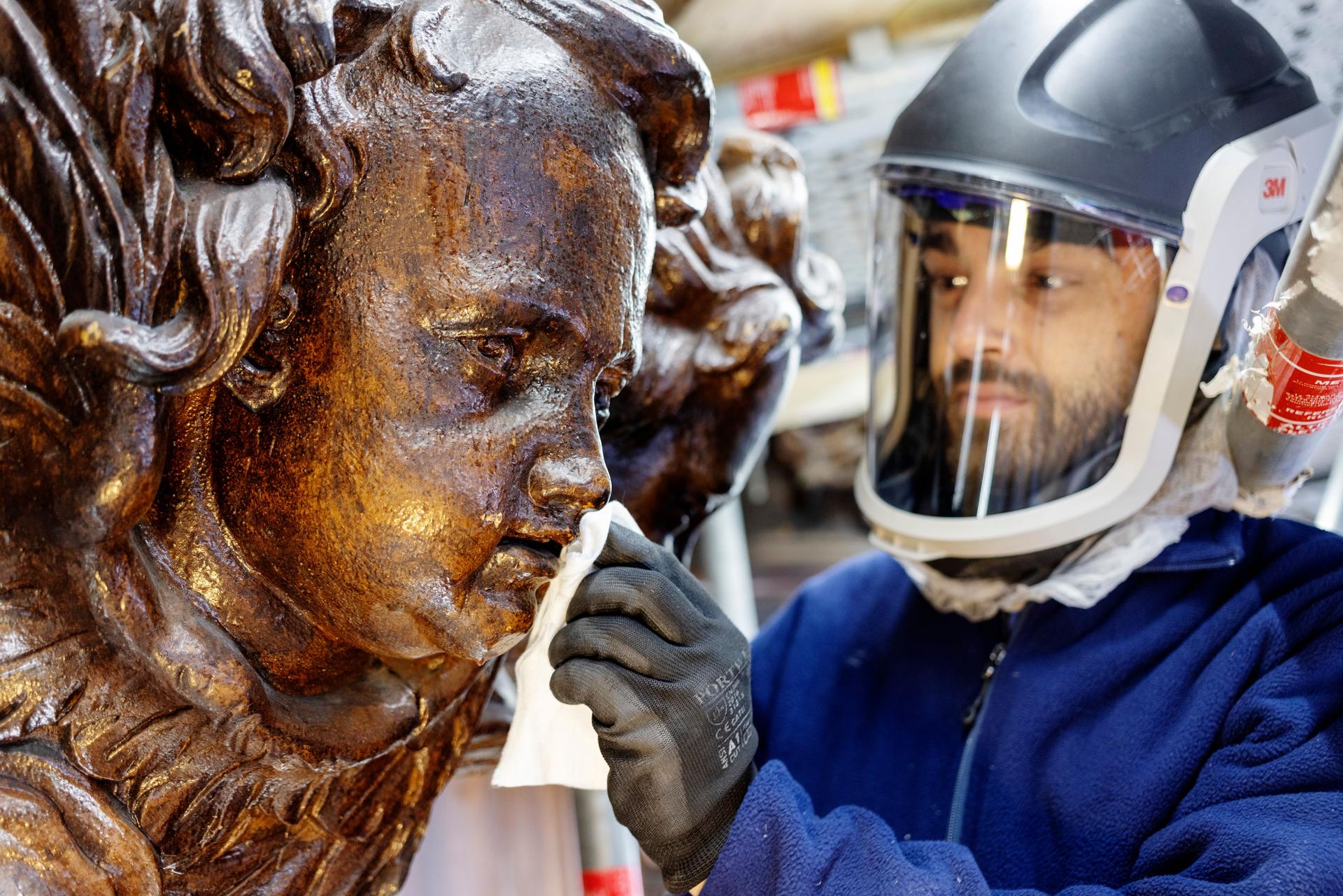

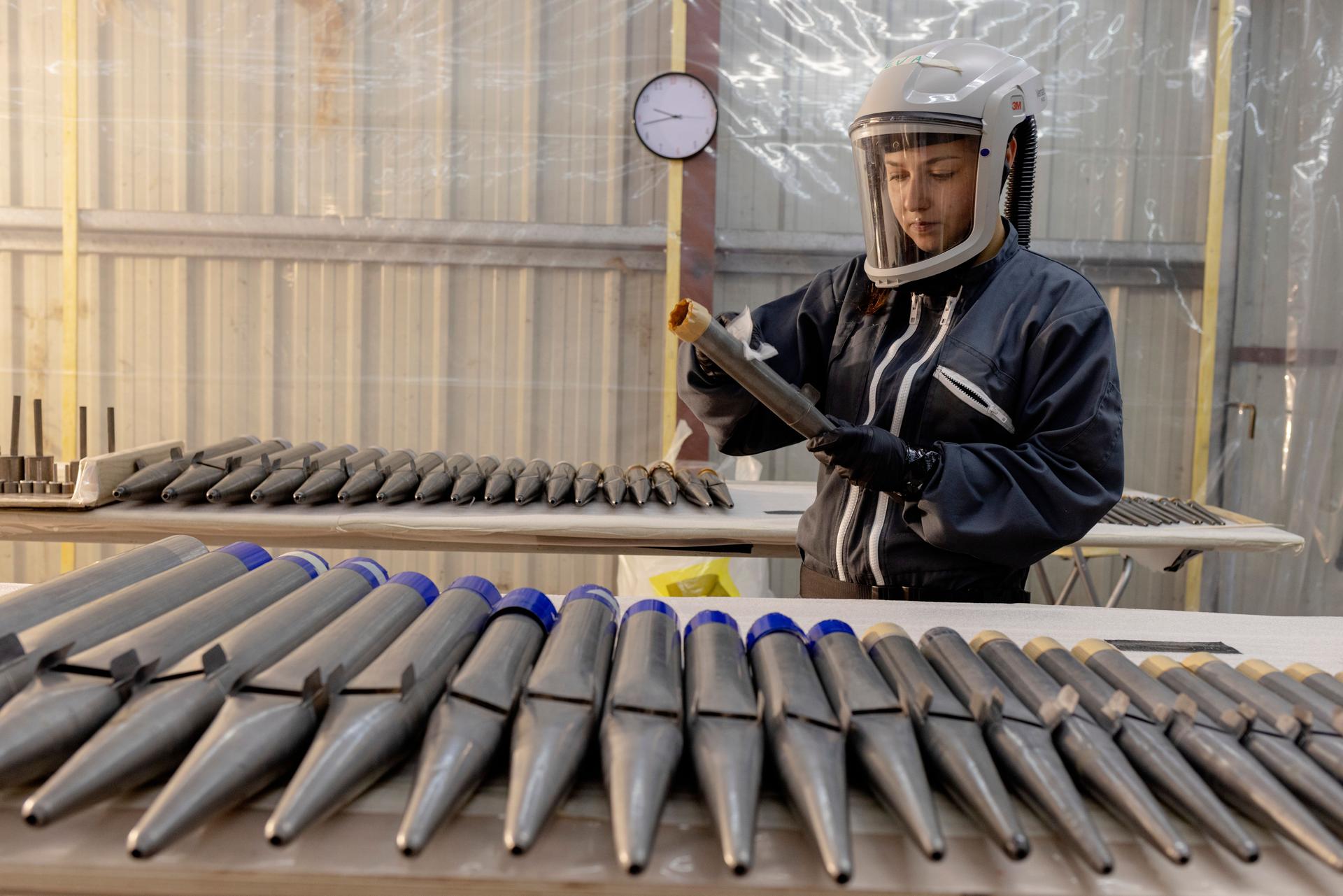
The organ’s 8,000 dusty pipes were removed during the safety phase and cleaning work began in October 2021. A project in its own right, the operation was entrusted to three groups of organ builders.
In the cathedral, restoration of the case and cleaning of the large pipes
Some of the largest parts of the organ were too fragile or bulky to be removed and were left in place on the western platform of the cathedral, in order to be restored on site. These included the front rank, around 20 large wooden pipes, the four large bellows, and of course the organ case, which is the oldest part of the organ and dates from the mid-18th century.
Restoration of the bellows began by exchanging their old sheepskins for new ones. To ensure sufficient air flow into the instrument, the bellows must be completely airtight and the glue must be applied at a temperature over 20°, so this operation had to be carried out in summer. As for the case, which had been covered in successive layers of paint over the years, it was carefully restored by an organ painting and decoration restorer, who stripped the layers of paint back to the original colors and refreshed the varnish.
In fall 2022, the large pipes were dusted to remove layers of dust that were covering them.
In the workshops, restoration of the pipes and musical mechanisms
All the pipes removed during the safety phase were restored in Vaucluse. The organ builders had to adapt their workshop by creating a sealed space with a decontamination airlock for entering and exiting the zone. For over a year, the different-sized pipes, which vary from the size of a lipstick to several meters tall, were individually dusted and cleaned.
After decontamination in Corrèze, restoration of the 19 wind chests - devices that control the air flow to the pipes – began in spring 2022 in a workshop in Hérault, using the same techniques as those used in the time of Cavaillé-Coll, based on sheepskin and animal glue to form a sack and bellows that expel the air and make the pipes vibrate.
The wind chests were then wired. Only the transmission between the keys and the pipes, which is electric for the notes and pneumatic with compressed air for the registers, were partially renewed and updated with more recent technological innovations already applied to the organ console in 2014.
Reassembly and voicing of the instrument
In early 2023, the wind chests were returned to the organ case, followed by the 8,000 pipes to allow them to be gradually assembled.
2024 sees the voicing of the great organ: for six months, at night to ensure optimal acoustic conditions, around 30 organ builders carry out the tonal finishing so that the fully functional organ is ready to welcome all those who enter the cathedral in 2024.
Main visual ©Patrick Zachmann – Magnum Photos / RNDP