

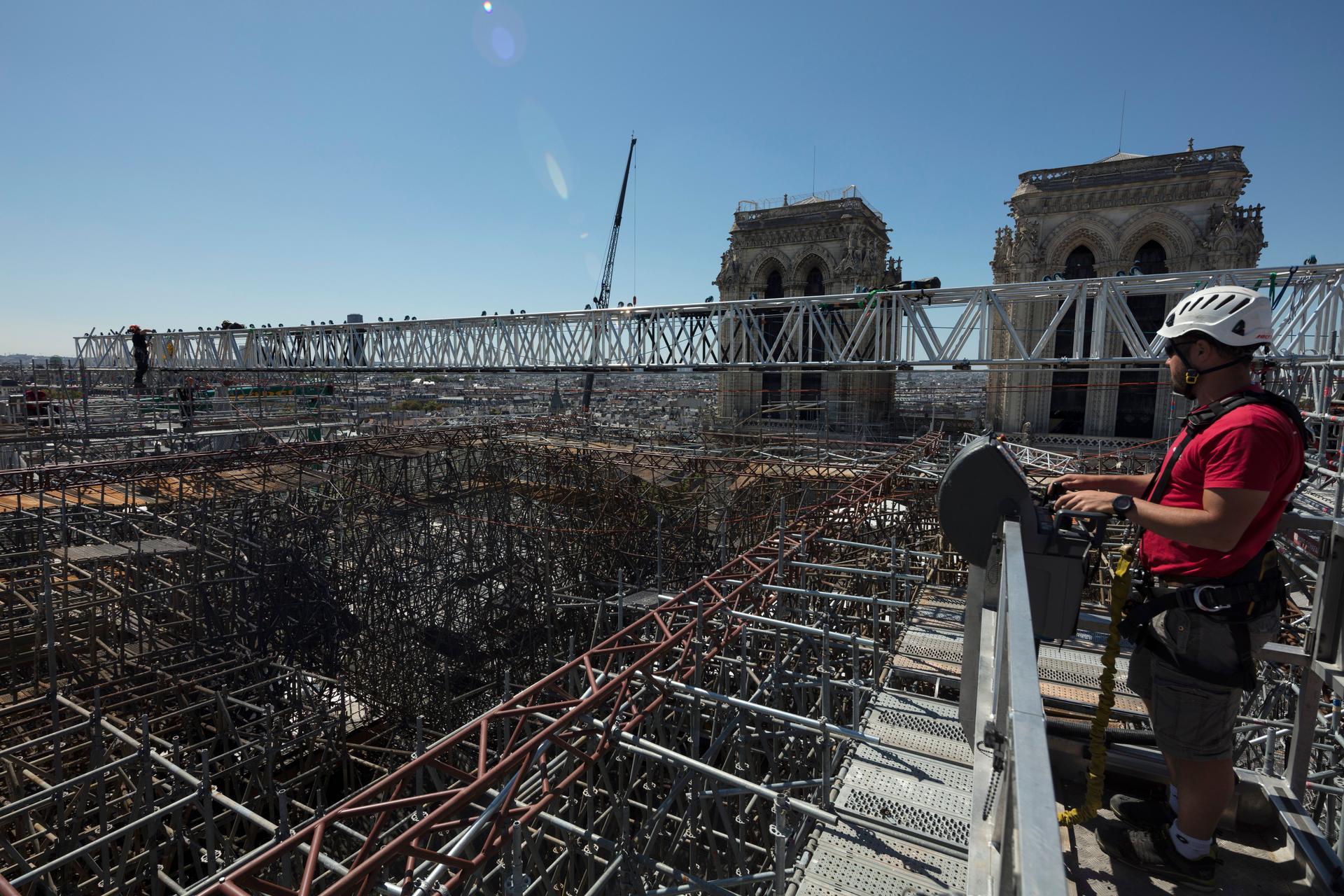
Aerial lift operators specialize in accessing elevated positions in a matter of minutes. At the controls of their aerial lifts, they provide safe work platforms when it is impossible to use scaffolding.
Aerial lift operators work alongside all the trades operating at high level. They must therefore be capable of working as part of a team and developing a precise understanding of their colleagues’ needs. Although aerial lifts are designed to accommodate several people, aerial lift operators sometimes work alone and are directly responsible for conducting high-level operations.
In addition to being experienced equipment operators, aerial lift operators must be versatile and highly organized with a perfect understanding of safety rules.
On the Notre-Dame de Paris site
Aerial lift operators play an essential role on the Notre-Dame de Paris site because many operations are conducted at high altitude.
During the securing phase, oversized aerial lifts enabled specialized teams to intervene in the most sensitive parts of the site. The aerial lift operators’ work enabled the carpenters to secure the gables in record time, and their pinpoint control of the aerial lifts enabled scaffolders to dismantle the damaged scaffolding piece by piece. This was an extremely delicate operation, as it had to be carried out without putting any strain on the cathedral walls.
Aerial lift operators continue to intervene during the restoration phase, which includes many high-level operations.
How to become a aerial lift operator?
CAP or BEP vocational certification in the transport and logistics field is beneficial. However, no formal qualifications are required to become a aerial lift operator.
The CACES aerial lift operation licence is the only authorization required to operate aerial lifts.
In certain cases, practitioners of technical trades may develop complementary expertise as aerial lift operators.